How Far Does It Go Before It Is at Ground Level Again
Projectile motility: two separate motions
This blitheness shows the parabolic path of a ball rolled off of something like a table and then immune to fall freely. Click play to set it in motion. The projectile is the magenta brawl; the green balls represent its horizontal and vertical velocities.
Notice that the horizontal velocity is constant, while the downward movement is accelerated. Run the animation a few times looking at different aspects of the motion. Await at both the forward progress (elevation) and the downward progress (left) of the ball.
The essence of how we treat projectile movement, the motion of a launched object afterwards no more launching forces are working on it, is in this figure: The horizontal velocity (ignoring friction) is constant, and the vertical acceleration is only that of a freely-falling object.
Consider the forces at work on a brawl while it's rolling along the table. We assume that a force was or is being applied that created a constant velocity vx . The force of gravity, Fg , on the brawl is exactly balanced past the normal force, FN , of the table pushing back on the ball.
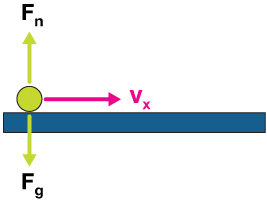
Now equally the ball rolls off the table, the normal force vanishes and the force of gravity pulls information technology down. Unbalanced forces produce acceleration, so the ball will accelerate downwardly at 9.8 chiliad/s2. There is no force interim horizontally (except for friction – air resistance), so the forward velocity will remain fivex

Equally the ball falls, two things are going on independently. First, the ball is traveling forward at a abiding velocity. You can encounter that past the even spacing of the tick marks along the horizontal centrality in the effigy below.
Every bit time unfolds, the downwards velocity of the ball increases at the charge per unit of ix.8 k/south2, creating the uneven spacing in the vertical location of the ball (ticks on vertical axis).

That'south the essence of projectile motility, no matter how complicated the scenario: Nature doesn't care about whether a projectile is moving horizontally. It'southward still going to exist acted on by the force of gravity just as though information technology were dropped or thrown straight upward.
Example one
A ball rolls off the top of a 1.five m tall table with a horizontal velocity of 2.0 ms-i. Calculate how far the ball will travel from the table before it hits the floor.

When the ball rolls off the edge of the table, it will continue moving forrard at 2.0 m/s until it hits the floor. So we just demand to find out how long information technology volition be in the air before it hits.
For that, we'll use the freefall formula, rearranged to give united states of america the time. What's crucial here is to realize that, when it comes to the vertical dimension, the ball is acting just similar a dropped ball. Nature doesn't care that it'southward besides moving forward at the same time.
$$d = \frac{1}{2} gt^2 \; \longrightarrow \; t = \sqrt{\frac{2d}{g}}$$
Plugging in the height of the tabular array and the dispatch of gravity, we become the time in seconds:
$$ \crave{cancel} t = \sqrt{\frac{2(1.5 \cancel{m})}{ix.viii \cancel{k}\cdot s^{-two}}} = 0.553 \; s$$
So the ball volition be in the air (and thus able to move forwards) for a piffling more than half a 2nd. Now we merely rearrange the speed equation,
$$s = \frac{d}{t} \; \longrightarrow \; d = st$$
and plug in the speed and time to go the distance traveled:
$$ \brainstorm{align} d &= ii.0 \frac{m}{\cancel{s}} (0.553 \cancel{due south}) \\[5pt] &= \bf ane.eleven \; \text{m} \end{align}$$
The ball will travel most 1.1 meters earlier striking the ground.
Projectile motion bug always take this kind of ii-step structure (at least).
Example ii
A baseball game is hit so that it takes off at a 45˚ angle with respect to the ground and with an initial velocity of 40 thou/s. How far would the ball travel if there were no debate or wall to hit?

Nosotros'll need to suspension that initial velocity vector into its vertical and horizontal components to go the vertical velocity, vy and the horizontal velocity vx . To do that we can use the 45-45-ninety triangle, which you should memorize.

The length of a side of the 45-45-90 triangle is $\sqrt{2}/2$ times the length of the hypotenuse, and then our hitter diagram looks like this:

Now to find the total fourth dimension in the air, we use the definition of acceleration to find the fourth dimension it takes the brawl to get to the top of its arc, the acceleration in this instance beingness $one thousand = 9.eight m/s^ii.$ Nosotros can rearrange that definition to detect the elapsed time.
$$g = \frac{\Delta v}{\Delta t} \; \longrightarrow \; \Delta t = \frac{v_f - v_i}{g}$$
We are able to calculate the time because the velocity at the top of the arc, vf , is zero. The i-way time is:
$$\Delta t = \frac{0 - 20\sqrt{two}}{-9.8} = 2.886 \; south$$
The round trip time – upward and down – is twice that, 5.772 s. Now information technology'southward just a thing of calculating the distance traveled during that time, given that the horizontal velocity is $xx \sqrt{two} \, m/s.$
$$ \begin{align} &= 20 \sqrt{2} (v.772) \\[5pt] &= 163 \, m \; \; \text{ or 535 ft.} \end{align}$$
This is a pretty typical projectile motion trouble that you should know how to solve.
Recollect that this distance is actually an upper limit to the distance that the ball could travel. In reality, air resistance would boring its travel a chip and the distance would decrease.
Example 3
Using trigonometry to solve projectile motion issues
A sure cannon has a muzzle velocity of ninety chiliad/due south. Calculate the distance a cannonball would travel if launched at angles of 40˚, 45˚ and 50˚ with respect to apartment ground.

The question we're really asking hither is, which angle is the best for achieving the largest altitude of the shot? We'll gauge that it's 45˚ and examination an angle on either side, 40˚ and 50˚.
This problem will require a little trigonometry considering not all of those angles vest to user-friendly memorized triangles. The vertical (vy ) and horizontal (vx ) components of the cage velocity (that's only ammunition talk for the velocity of the cannonball or bullet equally it exits the barrel) are shown here:

Let's summate those vector components of the velocity for each angle using the sines and cosines:

Now we need to calculate the total time in the air using the definition of acceleration and the fact that the vertical velocity at the top of the arc is zero. The gene of 2 in this equation accounts for the circular-trip up and back down.

Here are the results for each angle:

Now to calculate the distances using the horizontal velocities and the fourth dimension interval,
$$d = v_x \cdot \Delta t$$
Finally, hither are the distances:

Indeed, the 45˚ bending yields the greatest distance. This is always truthful for a given initial velocity, all other conditions being equal.
Example 4
Diff upward and downward distances
Let'due south look at another cannon problem. A cannon (muzzle velocity 110 m/south) located at the edge of a 50 grand cliff is shot upward at a 55˚ angle. How far from the base of the cliff (assume that the cliff wall is vertical) will the cannonball country? Assume that the cannon cage is 1.5m above the flat ground on top of the cliff.

In this trouble, we'll be a piddling more precise and take the summit of the muzzle of the cannon into account, besides.
The first step is to calculate vertical and horizontal components of the initial velocity, vy and vten :
$$ \brainstorm{marshal} v_x &= 110 \cdot cos(55˚) = 63.09 \; \frac{thou}{s} \\[5pt] v_y &= 110 \cdot sin(55˚) = 90.11 \; \frac{m}{due south} \stop{align}$$
At present to summate the distance and time to the peak of the arc. The full time volition have to be calculated in two steps because the up and down distances are unlike.
$$\Delta t_{upwards} = \frac{0 - v_y}{g} = 9.195 \; 1000$$
We'll need the upward distance in order to calculate the time to the lesser of the cliff.
$$ \brainstorm{align} d_{up} = v \cdot \Delta t_{up} &= \frac{90.11 \, \frac{k}{\cancel{southward}} (9.195 \cancel{due south})}{2} \\[5pt] &= 414.3 \; m \cease{align}$$
The velocity in that terminal step is the average velocity of the climb, the average of xc.11 chiliad/s and 0.0 m/due south. Now the fourth dimension it takes for the projectile to autumn is calculated from a rearranged freefall equation and by calculation 50 m + 1.5 m to the upward distance:
$$ \begin{align} \Delta t_{downwards} &= \sqrt{\frac{2d}{chiliad}} \\[5pt] &= \sqrt{\frac{2(414.iii + 51.v)}{g}} \\[5pt] &= ix.749 \, south \cease{align}$$
Now the full time that the projectile spends moving forrard (before it hits the ground) is
$$ \begin{align} \Delta t &= 9.749 + 9.195 \\[5pt] &= 18.944 \; s \end{align}$$
Finally, every bit always, we use the horizontal velocity and the total time to calculate the distance traveled:
$$ \begin{marshal} d = v_x \cdot \Delta t &= 63.09 \frac{g}{\cancel{south}} \cdot 19.944 \cancel{s} \\[5pt] &= 1258 \; 1000 \end{align}$$
That'due south pretty far. The cliff gives us an advantage. Can you lot call up of a unproblematic change that would give us fifty-fifty more distance?
Algorithm for solving projectile-motion problems
| Footstep | Procedure |
|---|---|
| 1. | If necessary, resolve the initial velocity vector into horizontal (vx ) and vertical (vy ) components |
| two. | Utilize vy to calculate the total time in the air. Have extra intendance if the projectile doesn't originate and land at the same height. |
| three. | With the time, calculate how far the projectile would move horizontally at a constant velocity of 510 |
Practice problems
| 1. | A ball is launched directly upward with an initial velocity of three.0 m/south. The point where the brawl exits from the mechanical launcher is 0.25 m from the ground. How high to a higher place the ground will the ball go? | |
| 2. | If a ball shot vertically rises to a superlative of two.35 meters, what was its initial velocity? | |
| three. | A brawl rolls toward the edge of a 37 m tall vertical cliff at a velocity of 5 k/due south. Calculate how far the ball will be from the cliff when it hits the ground. | |
| 4. | A suitcase was dropped from a plane traveling at 300 yard/due south at an altitude of 35,000 ft. Calculate the horizontal distance, between the point where the suitcase was dropped and the point where it landed. Assume that there is no air resistance. (1m = three.28 ft.) | |
| 5. | A burglarize with a muzzle velocity of 829 yard/s is fired at a 32˚ angle with respect to the ground. Ignoring air resistance, how far abroad would the bullet country. Presume the bullet is fired from ground level. Does your answer make sense? | |
| 6. | Consider the case of a shot putter throwing a 9 lb. shot put in a contest. To accomplish optimum distance, the thrower hurls the steel ball at a 45˚ upward angle. He can generate enough dispatch of the shot to accomplish an initial velocity of 14.1 grand/s. How far will the shot put wing? Assume that the release point is 8 ft. off the ground and that the ball lands on level ground. The world record in the men'south shot put event is 23.12 m |
Video examples (coming presently)
Here are four examples of how to solve projectile-motion problems.
Example 1
A brawl rolls off a table with a given initial velocity. How far from the edge of the tabular array will information technology hit the floor?
Minutes of your life: 0:00
Example ii
A cannon is fired on level basis at a given muzzle velocity (initial velocity) and a 30˚ bending. How far will the cannonball travel earlier hitting the ground?
Minutes of your life: 0:00
Example 3
A cannon is fired from the top of a high cliff with a given cage velocity and bending with respect to the horizontal. Summate the horizontal distance that the ball volition travel.
Minutes of your life: 0:00
Example 4
A cannon is fired with a muzzle velocity of thirty m/south at a 35˚ angle toward a 30 m high plateau 120 m abroad. Will the ball clear the top of the plateau?
Minutes of your life: 0:00
Source: https://xaktly.com/ProjectileMotion.html
0 Response to "How Far Does It Go Before It Is at Ground Level Again"
Enregistrer un commentaire