Was It Called Again Public Floor
Some myths become dorsum millennia.
This myth, if information technology is one, goes dorsum to 1990 -- and just over 3 decades later, it continues to course a central grievance in Russian President Vladimir Putin'south testy narrative about Moscow's ties with the West.
It's the question of NATO expansion -- an unhealed scab that, with Russian-Western relations at their everyman ebb since the Cold War, has been picked off however again and is now bleeding into public view.
Casting the issue into the spotlight this time was not an angry tirade from Putin but a report by the London-based think tank Chatham House, which, in a May 13 publication, aimed to dispel a host of what information technology called "myths and misperceptions" that accept shaped Western thinking and kept information technology from establishing "a stable and manageable human relationship with Moscow."
1 "myth" in particular kicked off a furious contend in eastward-postal service threads, chat rooms, listservs, and on Twitter: "Russian federation was promised that NATO would not enlarge."
"The U.S.S.R. was never offered a formal guarantee on the limits of NATO expansion post-1990," John Lough, the research associate who authored the section, wrote. "Moscow merely distorts history to help preserve an anti-Western consensus at home."
Nikolai Sokov, a former Russian diplomat who served in the Foreign Ministry in Moscow between 1987 and 1992, disagrees. "The Chatham Firm piece is very bad -- it sounds to be as a slice produced past the Ideology Section of the Central Committee" of the Communist Party of the Soviet Spousal relationship, he told RFE/RL.
"We didn't have to come to this, though, and the issue could accept remained a small script in history that does not need to exist resolved," he said. "It is more about the mode of NATO enlargement and the arguments used to promote enlargement."
So, more than two decades later on NATO'southward original 16-member Common cold War limerick was starting time enlarged to have in three erstwhile Warsaw Pact states, and with Putin poised to potentially stay in role into the 2030s, the past is very much present.
"We are yet debating it because the proponents of enlargement believe they acted honorably and helped millions of people who had been under Soviet domination attain their liberty," said Jim Goldgeier, who served on the National Security Quango nether President Neb Clinton in the 1990s.
"The Russian narrative is the West deceived them and acted in a way that left them out of mail-Cold State of war Europe. Information technology's just very hard to bridge these positions, and emotions exercise run high, given that the hopes 30 years ago of Russia being part of Europe didn't materialize," Goldgeier told RFE/RL. "So there are those who want to blame the West, and those who desire to blame Putin."
'Not On The Calendar'
For many Cold State of war scholars, the genesis of the narrative can be primarily traced dorsum to a February 1990 visit by James Bakery, the U.South. secretary of state nether President George Bush, to Moscow, where Bakery met with Soviet leader Mikhail Gorbachev.
The Berlin Wall had come down three months before, and Western leaders were openly discussing whether a divided Germany would be reunified, something that Moscow feared -- and if that happened, whether NATO forces would ultimately be stationed in what was then Due east Germany, something that terrified Moscow.
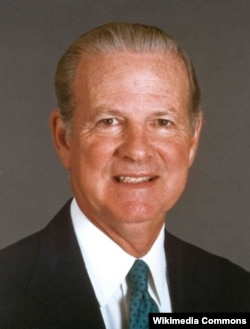
According to transcripts released years later by the Us and Russia, Baker broached the subject with the argument that it was better to have a unified Germany within NATO's political and military structure than outside of it.
"At no point in the give-and-take did either Baker or Gorbachev bring upwardly the question of the possible extension of NATO membership to other Warsaw Pact countries across Germany," according to Mark Kramer, director of the Cold War Studies Project at Harvard University's Davis Heart, who reviewed the declassified transcripts and other materials.
"Indeed, it never would accept occurred to them to raise an upshot that was non on the calendar anywhere, not in Washington, non in Moscow, and not in any other Warsaw Pact or NATO capital," Kramer wrote in a April 2009 journal commodity.
Gorbachev met with West German language Chancellor Helmut Kohl the 24-hour interval later the meeting with Baker. According to Kramer'southward research, the subject of High german unification was more prominent on the agenda than it had been with Baker. "Gorbachev did not seek whatever assurances about [NATO enlargement] and certainly did not receive any," Kramer wrote.
Ultimately, according to Steven Pifer, a one-time U.South. administrator who was serving at the State Section at the time, the U.s., French republic, and Britain, along with Germany, agreed non to deploy non-German NATO forces in the onetime East Germany.
In 1999, years subsequently German language reunification and the withdrawal of all Soviet troops from Eastern Europe, NATO admitted iii sometime Warsaw Pact countries: Poland, the Czech Republic, and Hungary.
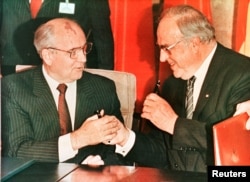
10 years afterwards, in an interview with the German newspaper Bild, Gorbachev complained that the West had tricked Moscow. "Many people in the West were secretly rubbing their hands and felt something similar a flush of victory -- including those who had promised us: 'We will not movement i centimeter further east,'" he was quoted as saying.
Gorbachev later appeared to contrary himself, proverb the subject of enlargement in fact never came up in 1989 or 1990. "The topic of 'NATO expansion' was never discussed; it was not raised in those years. I am saying this with a full sense of responsibility. Not a unmarried Eastern European state brought upward the issue, not even afterwards the Warsaw Pact had ceased to exist in 1991," he told the newspaper Kommersant in Oct 2014.
Gorbachev could not be reached for annotate. A spokesman did not immediately return an email.
'The Spirit Of The Treaty'
Russia'southward beginning president, Boris Yeltsin, was wary almost NATO expansion but did not oppose information technology, co-ordinate to declassified memos. "We empathise, of course, that whatsoever possible integration of E European countries into NATO will not automatically pb to the alliance somehow turning against Russia," Yeltsin wrote in a September 1993 letter to U.South. President Bill Clinton. "Only it is of import to take into account how our public opinion might react to that step."
Simply Yeltsin also cited what he cast as assurances given to Soviet officials during the negotiations on High german unification, writing that "the spirit of the treaty on the final settlement...precludes the pick of expanding the NATO zone into the East."
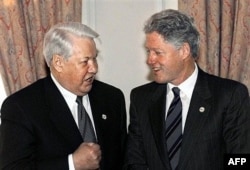
Four years later, in an effort to assuage Moscow'due south concerns, NATO and Russia signed the NATO-Russian federation Founding Deed, a political agreement stating, among other things, that "NATO and Russia do not consider each other as adversaries." In 2002, NATO and Russian federation agreed to ready a joint consultative quango, ostensibly as a venue to resolve disagreements. Simply the council was seen as ineffectual by many in Moscow.
Then, two years later, NATO underwent the largest expansion in its history, admitting seven more than Eastern European countries, including the Baltic states of Estonia, Latvia, and Republic of lithuania, which had been republics of the Soviet Matrimony and chafed under Moscow's rule. While it wasn't the first time a NATO member bordered Russia or the Soviet Matrimony, now a NATO member'due south troops potentially could be located but 625 kilometers from Moscow.
In 2007, at the Munich Security Conference, an almanac high-level gathering of officials, diplomats, and experts from both sides of the Atlantic, Putin unleashed a broadside against NATO, as well as the Us, accusing the brotherhood of duplicity and of threatening Russia.
"I recollect it is obvious that NATO expansion has no relation with the modernization of the brotherhood itself or with ensuring security in Europe. On the contrary, information technology represents a serious provocation that reduces the level of mutual trust," he said.

"What happened to the assurances our Western partners made afterwards the dissolution of the Warsaw Pact? Where are those declarations today?" Putin asked -- a remark that prompted some head-scratching, because the debate has focused well-nigh exclusively on remarks made before the Warsaw Pact savage autonomously. "Where are these guarantees?"
A year after Putin'due south voice communication, at a Bucharest summit in Apr 2008, NATO declined to offer Georgia and Ukraine a fast-rails path to membership but assured the 2 countries that they would eventually join the alliance.
4 months subsequently, Russia invaded Georgia, destroying its war machine, occupying ii regions that had already had nigh complete autonomy, and humiliating the country'southward then-president, Mikheil Saakashvili, who had openly called for Georgia to join NATO.
In 2014, afterwards Russia seized Ukraine's Crimea Peninsula and equipped, financed, and provided military support to separatist fighters in eastern Ukraine, stoking a state of war that continues today, NATO chosen off whatever consultations with Russia.
Shortly after Russia'southward parliament endorsed the takeover of Crimea, Putin said in a speech that Russia was humiliated past NATO's expansion. "They take lied to us many times, made decisions backside our backs, placed us before an achieved fact," he claimed.
'Selling The Narrative'
Amongst those who have fueled Russian claims of a promise was the final U.Due south. ambassador to the Soviet Union, Jack Matlock, who has repeatedly insisted, both in congressional testimony and more recently, that Gorbachev had received assurances that if Germany united, and stayed in NATO, the borders of NATO would not move eastward.
Simply Wolfgang Ischinger, a erstwhile German ambassador and deputy foreign minister who is now head of the Munich Security Conference, said that agreements on German reunification, including the 1990 treaty known as the two+4 Treaty, which formally paved the fashion for the two countries to get 1 once more, made no mention of NATO enlargement.
"Russia has been quite successful in selling the narrative that, in exchange for their acceptance of German unification via the 2+four Treaty, they were promised that there would be no NATO enlargement," Ischinger told RFE/RL. "Russian federation presents herself as the victim."
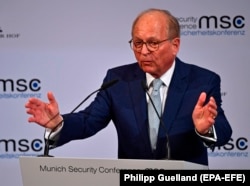
"Whatever promises nearly not-enlargement may have been discussed...in 1990, the hard fact is Russia accepted enlargement, with detailed conditions, and in writing, when the NATO-Russia Founding Act was agreed," Ischinger said in an e-mail. "After Russian claims that unlike promises had been made in 1990 are therefore simply not relevant. In fact, this is propaganda, and it is in bad faith!"
Sokov, the one-time diplomat who is now at the Vienna Center for Disarmament and Non-Proliferation, said the biggest issue was that NATO's enlargement could accept been "managed" to minimize misunderstandings.
A Missed Take a chance?
The initial expansion, in 1999, came effectually the time of the NATO bombing of Yugoslavia, aimed at stopping advances by Serbian forces confronting the Kosovar population. Russia's outrage over the campaign was crystallized past the decision of then-Prime Minister Yevgeny Primakov to turn his U.S.-bound jet around over the Atlantic Ocean in protest. The 2003 U.S. invasion of Republic of iraq was another activeness that raised Moscow's ire.
"It is wrong to wave away Russian concerns," Sokov said.
The 1997 Founding Act was well-intentioned, as was the 2002 creation of the NATO-Russia Council, he said. But he argued that these agreements have "never worked," arguing that the alliance often takes actions that affect Russian or regional security without consulting Moscow.
"The process that is used instead is that NATO makes a decision then tries to convince Russia that [the] determination is good and should be accepted. The latter is a formula for disaster," he said. "I strongly believe that information technology was possible to both enlarge NATO and avoid conflict. The chance was missed and today we see a worsening disharmonize of which the question about guarantees given by Baker is nothing but a symbol."
But for other scholars, the problem lies mainly in Moscow, with the way Putin and the Kremlin perceive the history of NATO enlargement and the way they nowadays information technology to the Russian public and the West.
"The notion that NATO made and broke a promise that it would non accept any new member states in Eastern Europe is i of the core ideas driving Russia'southward view of a hostile W," said Keir Giles, a consultant and co-author of the Chatham House report.
And that seems unlikely to change anytime shortly.
In an article for the Brookings Institution in 2014, Pifer, the former ambassador, predicted that for Putin, "The Due west'southward alleged promise non to enlarge the brotherhood volition undoubtedly remain a standard element of his anti-NATO spin.
"That is because it fits so well with the movie that the Russian leader seeks to paint of an aggrieved Russia, taken advantage of by others and increasingly isolated -- non due to its own actions, but because of the machinations of a deceitful West," Pifer said.
Source: https://www.rferl.org/a/nato-expansion-russia-mislead/31263602.html
0 Response to "Was It Called Again Public Floor"
Enregistrer un commentaire