When Will Australian Show Redfern Start Again
| Redfern At present | |
|---|---|
 | |
| Genre | Drama |
| Written by | Jon Bell Wayne Blair Michelle Blanchard Danielle MacLean Steven McGregor Leah Purcell Adrian Russell Wills |
| Directed past | Rachel Perkins Wayne Blair Leah Purcell Catriona McKenzie Adrian Russell Wills Beck Cole |
| Starring | Jimi Bani Wayne Blair Dean Daley-Jones Rarriwuy Hick Johnny Lever Deborah Mailman Marley Sharp Kelton Pell Leah Purcell Tessa Rose Shari Sebbens Miranda Tapsell |
| Opening theme | "Lonely Child" by Kira Puru |
| Land of origin | Australia |
| Original language | English language |
| No. of series | 2 + 1 telemovie |
| No. of episodes | thirteen |
| Production | |
| Executive producers | Erica Glynn Sally Riley |
| Producers | Darren Dale Miranda Dear |
| Production locations | Redfern, Sydney, Australia |
| Cinematography | Mark Wareham Jules O'Loughlin |
| Editors | Dany Cooper Nicholas Holmes |
| Running time | 60 minutes |
| Production company | Blackfella Films |
| Distributor | Australian Dissemination Corporation |
| Release | |
| Original network | ABC1 |
| Motion picture format | 576i (SDTV) |
| Audio format | Stereo |
| Original release | ane November 2012 (2012-11-01) – 9 April 2015 (2015-04-09) |
| External links | |
| Website | |
| Production website | |
Redfern Now is an Australian drama goggle box series, that first aired on ABC1 in 2012. The program follows the lives of vi Aboriginal Australian families living in the urban hub of Redfern, Sydney. The series provides insight into contemporary issues facing Aboriginal Australians, including lack of employment and mental illness, which are positioned as direct ramifications of colonialisation and the Stolen Generations. Produced by Blackfella Films as part of the ABC's Indigenous Department, the show is the start series to be 'commissioned, written, acted and produced by Indigenous Australians'.[1] The serial' release contributes to widespread public argue surrounding Indigenous representation in the Australian media.
The first season received 5 AACTA award nominations for 2013.[2] The serial has received numerous additional AACTA nominations, winning 5 in total, including All-time Lead Actress in a Boob tube Drama for Leah Purcell, Best Screenplay in Idiot box, and Best Television Drama Series.
A second flavor was commissioned in tardily 2012[3] and went into product in May 2013,[four] premiering 31 October 2013.[5] The serial concluded with a telemovie titled Promise Me which aired on 9 April 2015.[6]
Cast [edit]
- Wayne Blair equally Lawman Aaron Davis (2012–2015)
- Dean Daley-Jones as Indigo (2012–2015)
- Deborah Mailman as Lorraine Blake (2012–2015)
- Richard Green as Nathan (2012–2015)
- Lisa Flanagan every bit Allie (2012–2015)
- Kelton Pell as Raymond (2012–2015)
- Rarriwuy Hick as Robyn Davis (2012–2015)
- Kirk Page every bit Peter (2013–2015)
- Leah Purcell every bit Grace Nielson (2012–2013)
- Tessa Rose equally Coral (2012–2013)
- Shari Sebbens every bit Julie (2012)
- Miranda Tapsell as Teneka (2012)
- Rhimi Johnson Page as Danny Blain (2012)
- Ursula Yovich every bit Nic Shields (2012–2013)
- Marley Sharp as Eddie Shields (2012–2013)
- Aaron McGrath as Joel "Joely" Shields (2012–2013)
- Madeleine Madden as Chloe (2012–2013)
- Stephen Curry as Constable Ryan Hobbs (2012–2013)
- Trisha Morton-Thomas as Aunty Mona (2012–2013)
- Oscar Redding as Richard (2013)
- Craig McLachlan as Jack (2013)
- Ernie Dingo equally Ernie Johnson (2013)
- Steve Bisley as Richard (2013)
- Meyne Wyatt as Justin Myles (2013)
- Tammy Clarkson Jones as Mattie Erica Collinson (2013)
Series overview [edit]
Episodes [edit]
Series 1 [edit]
Series 2 [edit]
Telemovie [edit]
Background and production [edit]
The ABC's Indigenous Department was founded in 2010, and headed by Aboriginal pic maker and producer Sally Riley.[1] As director of the department, Riley aimed to create content which advocated for Ancient self-representation, and allowed for increased participation of Indigenous creatives in the media manufacture.[15] Initial success for the department was accomplished through the production of the shows Kickoff Australians and Mabo.[1] Redfern Now took two years for the department to produce, and created more than than 250 jobs for Ethnic people in the film making industry.[15]
Sally Riley chosen upon British screen writer Jimmy McGovern to work on this series. McGovern's previous work which featured gritty realism and suburban life, was similar to what Riley envisioned for Redfern Now.[1] While he was unfamiliar with Aboriginal culture, McGovern was experienced in working with marginalised communities in U.k. and Ireland.[16] The Ethnic Section of the ABC had originally aimed to a create an Ancient spin-off of a series that McGovern has previously worked on called The Street. Although, purchasing the rights to recreate the serial proved too costly for the department, and then Riley and McGovern came up with the idea for Redfern Now.[16]
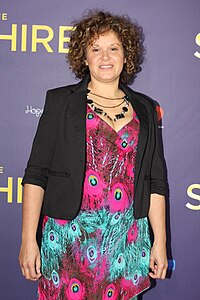
Leah Purcell, who worked alongside Jimmy McGovern in the screen writing process.
The screen writing process itself took place over 9 months, as McGovern piece of work shopped with five Aboriginal writers.[17] The series was based on truth according to McGovern who said, 'the actual writing was their responsibleness totally. But the shaping of the story we did together.'[18] It was vital to him that the series was not another documentary fashion history or autobiography that audiences had already seen on television.[eighteen] With footling technical experience in screen writing, key producer and writer Leah Purcell stated that McGovern's blunt feedback was 'absolutely what nosotros needed'.[xix]
Redfern At present was directed by a group of experienced Ancient people in the industry including Rachel Perkins, Catriona McKenzie and Leah Purcell. Wayne Blair, the managing director of award-winning Australian film The Sapphires, was a particularly notable manager involved in Redfern Now. [one] Blackfella Films, which produced Redfern Now, was established in 1992 by Rachel Perkins and her then business partner Michael Riley. The organisation focuses a collaborative, footing- up approach to film and idiot box making. The current managing director of Blackfella Films is Darren Dale.[20]
Setting [edit]
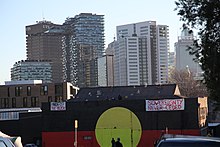
Redfern as part of the urban Sydney urban center landscape.
Inner city suburb Redfern, was an automatic option every bit the setting for this ABC serial. Today it is a dynamic and vibrant identify, which holds groovy cultural significance for the Aboriginal customs.[21]
Since the 1960s Redfern has been a site for Ancient activism and political attention. Redfern is widely recognised as the location of and then Prime Minister Paul Keating'south 'Redfern Speech' in 1992. This effect marked the Australian regime'due south first public acknowledgement of the dispossession of Aboriginal people and the need for reconciliation.[22] Redfern is also geographically in close proximity to the landing identify of the showtime European settlers in Sydney, thus is a relevant location to exist considering the impacts of colonialism on Indigenous people.[22]

'The Block' is a particular group of houses in Redfern endemic past the Aboriginal Housing Company, and is recognisable as the venue of the 2004 youth riots for Aboriginal rights.[21] It is the primary location within Redfern, where the characters in the serial interact and be with each other.
Despite its tumultuous history, Sarah Riley said Redfern is now a positive place.[21] It has a stiff Aboriginal culture, which is clear in the Indigenous art that marks the streets and parks in the suburb.[22] Aboriginal communities put a lot of important on place, and due to the long history of Ethnic people in Redfern, it now constitutes a place of belonging for many individuals.[22]
Theme song [edit]
Each episode opens with the song Solitary Child, performed by Indigenous Australian musician Kira Puru, and The Bruise.[23] The lyrics of the sombre song, 'reach out and touch me, take my hand, and walk me dwelling', reflect ascendant aspects of the storyline such as decolonisation. The song lyrics aimed to pose an atmosphere of openness for audiences, which could invite participation between Aboriginal and not-ancient Australian's in the process of healing.[24]
Themes, storyline and character [edit]
Each episode of the series introduces new characters, and explores a different social or political result that faces Aboriginal families in urban Australia. Every episode is able to be viewed discretely, without having seen other parts of the series.[25] While the storylines practice examine the disparities betwixt Aboriginal and non-Aboriginal Australians, Redfern Now is a fictional series that focuses on character journeys, rather than a documentary.[25]
Police force officeholder Aaron Davis, played by Wayne Blair, is the merely character to announced in multiple episodes throughout the series. The grapheme encapsulates the distress that many Indigenous people experience, due to the disparity that exists between representing the needs of their Ancient community while likewise trying to bide past white cultural norms. He is a character who has '1 foot in Redfern and one foot in the outside world', according to Metro Magazine.[26] The serial is relevant in exploring the ongoing argue within urban Ancient communities, centring effectually who can be classified as Aboriginal and who cannot be. This is salient in relation to character Julie, played past Shari Sebbens. The character is complimented on not looking Aboriginal, despite living with her Ethnic family in Redfern.
Despite these night and confronting storylines, the series is interspersed with intentional moments of humour. According to screenwriter McGovern, these are essential to keeping the viewer engaged in content that could and so easily go alienating. The comedic side of the prove stems from Aboriginal culture, where people are intent of finding 'humour in arduousness'.[1]
Aboriginal representation in film and television [edit]
Redfern At present has been 'ground breaking', because of how it confronts the historical style that Aboriginality has been divers on television.[1]
Australia's singled-out colonial history ways that representations of Aboriginal people on tv screens have traditionally been distorted and tokenistic, and contributed to perpetuating racist cultural stereotypes.[27] This results from non-Aboriginal people historically being positioned behind the photographic camera as storywriters, producers and directors, who objectify Ancient actors in front of the photographic camera.[28] There has been a clear distinction between the authors and subjects of creative works.
The concept of Aboriginality itself is a dynamic 'social thing', that is shaped through intercultural experiences and dialogue between not-indigenous and Indigenous Australians. As Aboriginal scholar Marcia Langton suggests, the predominant interactions that non-aboriginal audiences accept with Aboriginal people is through what they observe on television. So, it is essential that these representations are accurate and do not convey colonial tropes.[29]
The 1991 National Inquiry into Racist Violence, conducted by the Human Rights and Equal Opportunity Commission, expressed concerns almost the lack of diverseness on Australian Screens and encouraged increased recruitment of Ethnic people in the media industry.[30] Since then, representation has improved and so that while Aboriginal people make up 3% of the Australian population, they make up 5% of people in Australian television dramas.[31] Departments such as the government funded Screen Commonwealth of australia, and the ABC's Indigenous Department, accept been dedicated to leading the way in improving diverse representation.[32]
Redfern Now is centred effectually an Ancient community, as opposed to previous representations on television where Ancient people are cast as the friend or supporting actor. Aboriginal directors, producers and writers worked on the series, pregnant that characters could 'play roles written by them, not for them'.[one] Scholar Felicity Collins believes that it is these 18-carat representations which create an atmosphere of openness, that allow for audience engagement in the process of intercultural dialogue.[21]
Since Redfern Now, the ABC'southward Indigenous department have created other comedies and dramas of a similar nature. Shows similar The Gods of Wheat Street (2014), Black Comedy (2014), 8MMM (2015), and Cleverman (2016) were inspired past the success of Redfern Now.[32]
Reception [edit]
The series has generally received critical praise. Of the first episode Melinda Houston of The Age said, "Information technology makes for television that works on every level: every bit an of import cultural contribution, every bit a vehicle for sensational actors, writers, directors and technicians, every bit a not bad conversation-starter and equally a fabulous piece of drama."[33] Based on the second episode, Bob Ellis writes, "It was very well done indeed, and the mixture, similar Obama's Dreams From My Father, of honesty, eloquence and hope, bids fair... for a serial outcome that may well be seen, in sum, time to come, every bit a archetype."[34] After viewing the third episode, the idiot box writer for The Canberra Times writes, "Redfern Now is probably as important as whatsoever drama produced this year. This is actually mature and clever storytelling with the strangest gustation of an former O. Henry morality tale."[35]
Redfern Now received criticism from some conservative commentators. They questioned the shows separation of the identity of Aboriginal people living in urban settings, from the perceived 'accurate' rural Ancient identity.[36]
Generally feedback received was overwhelmingly positive, with The Sydney Morning Herald calling the showtime airing a 'landmark moment' for Australian television.[37] Metro Mag noted that the themes explored did not appear like tokenistic tropes, as they often have on other shows which explore Aboriginal issues. They reviewed that the nighttime themes simply existed in the background, and at the foreground were deep character explorations which assisted in presenting a rich and diverse culture.[36] The show did not appear overly political, because of a greater focus on domestic, emotive scenes.[38]
The serial received 7.ix/10 stars on IMDb.[39] The Guardian awarded the final telemovie iv/5 stars, stating that 'information technology will be missed, but the serial concludes at the peak of its power.'[38]
The series was bought by Netflix for sure regions. It has resonated with international audiences, beingness sold to France Televisions.[xx]
Graham Blundell, Australian actor and writer, admitted to expecting 'something grim and grey in tone' for a series set in Redfern.[forty] Instead, he noted in a review that the series was 'stylised and quite beautiful to look at'. Cinematographers Mark Wareham and Jules O'Loughlin have presented Redfern as a brilliant, sensory and vibrant identify. Attributing to this sense of Redfern as a multidimensional place, is the diverse settings which includes schools, homes, streets, alleys and cafes.[23]
See also [edit]
- Blackstone a Canadian television programme with a similar theme.
Awards and nominations [edit]
References [edit]
- ^ a b c d east f g h Nelson, Susanna. "Block Power: Redfern Now," Metro Mag: Media & Didactics Magazine 175 (2013): 46, doi: https://search-informit-com.au.ezproxy1.library.usyd.edu.au/documentSummary;res=IELAPA;dn=500651860751452
- ^ Kate Goodacre (4 December 2012). "AACTA Awards 2013 nominees: The Phonation Australia, The Sapphires, more". Digital Spy. Archived from the original on ix December 2012. Retrieved xix Dec 2012.
- ^ David Knox (thirteen November 2012). "Renewed: Redfern Now". TV tonight. Archived from the original on 21 November 2012. Retrieved 12 November 2012.
- ^ a b "Redfern Now season ii goes into production". Official website. Australian Broadcasting Corporation. 29 April 2013. Archived from the original on 12 May 2013. Retrieved 29 May 2013.
- ^ Blundell, Graeme (23 October 2013). "Redfern Now delves into the lives of ordinary people". The Australian. Archived from the original on xxx October 2013. Retrieved four November 2013.
- ^ "Hope Me telemovie to wrap Redfern Now". Idiot box Tonight. Archived from the original on 5 March 2016. Retrieved 21 September 2015.
- ^ a b "Redfern Now: Series 1 Ep 1". australiantelevision.net. Archived from the original on 22 August 2017. Retrieved 14 August 2017.
- ^ a b "Redfern At present: Series 1 Ep 2". australiantelevision.net. Archived from the original on 22 August 2017. Retrieved 14 August 2017.
- ^ a b "Redfern Now: Series ane Ep 3". australiantelevision.net. Archived from the original on 22 August 2017. Retrieved xiv August 2017.
- ^ a b "Redfern Now: Series 1 Ep 4". australiantelevision.cyberspace. Archived from the original on 22 August 2017. Retrieved 14 August 2017.
- ^ a b "Redfern Now: Serial i Ep 5". australiantelevision.net. Archived from the original on 22 August 2017. Retrieved 14 August 2017.
- ^ a b "Redfern Now: Serial 1 Ep vi". australiantelevision.net. Archived from the original on 22 Baronial 2017. Retrieved 14 August 2017.
- ^ a b "Redfern Now: Serial two". australiantelevision.net. Archived from the original on 22 August 2017. Retrieved fourteen Baronial 2017.
- ^ a b "Redfern Now: Promise Me". australiantelevision.net. Archived from the original on 22 August 2017. Retrieved 14 Baronial 2017.
- ^ a b "Emerge Riley," Academy of Wollongong Australia, accessed 2 October 2020. https://www.uow.edu.au/alumni/awards/previous-winners/emerge-riley/ Archived i November 2022 at the Wayback Machine
- ^ a b "Redfern Now," Storyline 34, (March 2014): 56.
- ^ David Knox (28 May 2012). "Cameras Roll on Redfern Now". Goggle box this night. Archived from the original on two June 2012. Retrieved 30 May 2012.
- ^ a b "Redfern At present," Storyline 34, (March 2014): 57.
- ^ "Redfern Now," Storyline 34, (March 2014): 60.
- ^ a b Groves, Don (June 2019). "Stories that say something". Inside Film. 189: xiv–16. Archived from the original on xviii November 2020. Retrieved 30 October 2020.
- ^ a b c d Collins, Felicity. "Blackfella Films: Decolonising urban Aboriginality in Redfern Now." Studies in Australasian Movie theater 7, 2-3 (Jan 2014): 215-225, doi: 10.1386/sac.7.2-3.215_1
- ^ a b c d "Redfern Park". Dictionary of Sydney. Archived from the original on 21 September 2020. Retrieved 1 October 2020.
- ^ a b Collins, Felicity. "Blackfella Films: Decolonising urban Aboriginality in Redfern Now." Studies in Australasian Cinema 7, 2-iii (Jan 2014): 218, doi: 10.1386/sac.vii.2-three.215_1
- ^ Collins, Felicity. "Blackfella Films: Decolonising urban Aboriginality in Redfern Now." Studies in Australasian Cinema 7, 2-3 (January 2014): 219-223, doi: 10.1386/sac.vii.two-3.215_1
- ^ a b Harkins- Cross, Rebecca. "Redfern Now (ABC)." Australian Book Review, 25 November 2012, https://www.australianbookreview.com.au/arts-update/101-arts-update/1253-redfern-now
- ^ Nelson, Susanna. "Block Power: Redfern Now." Metro Magazine: Media & Education Mag 175 (2013): 47, doi: https://search-informit-com-au.ezproxy1.library.usyd.edu.au/documentSummary;res=IELAPA;dn=500651860751452
- ^ Langton, Marcia. "Section Two: The Politics of Ancient Representation." In Well, I Heard it on the Radio and I Saw information technology on the Telly: An Essay for the Australian Picture show Commission on the Politics and Aesthetics of Filmmaking by and about Aboriginal People and Things, 24, Sydney: Australian Film Committee, 1993.
- ^ Langton, Marcia. "Section Two: The Politics of Aboriginal Representation." In Well, I Heard information technology on the Radio and I Saw it on the Tv: An Essay for the Australian Moving-picture show Commission on the Politics and Aesthetics of Filmmaking by and virtually Aboriginal People and Things, twoscore, Sydney: Australian Film Commission, 1993.
- ^ Langton, Marcia. "Section Ii: The Politics of Ancient Representation." In Well, I Heard information technology on the Radio and I Saw it on the Television set: An Essay for the Australian Pic Commission on the Politics and Aesthetics of Filmmaking by and about Aboriginal People and Things, 31, Sydney: Australian Pic Commission, 1993.
- ^ "Who gets to tell Australian Stories?" (PDF). Media Diversity Australia. June 2020. Archived (PDF) from the original on 11 November 2020.
- ^ "Milestone Report on Multifariousness in Television Released". Screen Australia. 24 August 2016. Archived from the original on 9 November 2020.
- ^ a b "ABC Indigenous Portal". ABC Ethnic. 2020. Archived from the original on 22 October 2020.
- ^ Melinda Houston (28 October 2012). "Critic's pick: The week ahead in TV". The Age. Archived from the original on xviii November 2020. Retrieved 21 November 2012.
- ^ Bob Ellis (10 Nov 2012). "The Redfern Saga (2)". Archived from the original on 14 November 2012. Retrieved 21 Nov 2012.
- ^ "Accelerate Australia fare". The Canberra Times. 17 Nov 2012. Retrieved 21 November 2012.
- ^ a b Nelson, Susanna. "Cake Ability: Redfern Now." Metro Mag: Media & Educational activity Magazine 175 (2013): 49, doi: https://search-informit-com-au.ezproxy1.library.usyd.edu.au/documentSummary;res=IELAPA;dn=500651860751452
- ^ Elliot, Tim (25 October 2016). "Redfern in Their Words". The Sydney Morning Herald. Archived from the original on 16 April 2019.
- ^ a b Buckmaster, Luke (x Apr 2015). "Redfern Now: Promise Me Review- concluding, unsettling showing from a superb cast". The Guardian Australian Edition. Archived from the original on eleven January 2019.
- ^ "Redfern Now". IMDb. Archived from the original on 17 April 2017.
- ^ Collins, Felicity. "Blackfella Films: Decolonising urban Aboriginality in Redfern Now." Studies in Australasian Picture palace 7, 2-iii (January 2014): 217, doi: 10.1386/sac.7.two-3.215_1
- ^ "ASSG - ASSG 2012 Award Winners". ASSG. Archived from the original on 7 May 2016. Retrieved 21 April 2016.
- ^ Knox, David (31 January 2013). "AACTA Awards 2013: Winners". TV Tonight. Archived from the original on 23 October 2013. Retrieved 16 Jan 2015.
- ^ Burgess, Matthew (7 April 2013). "2013 Logies Honour Blog". The Historic period. Fairfax Media. Archived from the original on 9 Apr 2013. Retrieved seven April 2013.
- ^ Aboriginal magistrate Pat O'Shane, Archie Roach honoured at Deadly Awards Archived 14 September 2013 at the Wayback Auto, ABC News, 11 September 2013.
- ^ Mair, Tracey. "WINNERS OF THE AUSTRALIAN DIRECTORS Order AWARDS Announced" (PDF). Australian Directors' Guild. Archived from the original (PDF) on 29 February 2016. Retrieved 21 Apr 2016.
- ^ "Awards 2013 | Australian Screen Editors". www.screeneditors.com.au. Archived from the original on 31 March 2016. Retrieved 21 April 2016.
- ^ "NSW/Human action 2013 Almanac Awards for Cinematography - Australian Cinematographers Society". www.cinematographer.org.au. Archived from the original on viii May 2016. Retrieved 21 Apr 2016.
- ^ "2013 Screen Music Awards: Best Music for a Boob tube Series or Serial". APRA AMCOS Commonwealth of australia. Archived from the original on 21 April 2015. Retrieved 21 April 2016.
- ^ AMCOS, APRA. "Best Television Theme | APRA AMCOS Commonwealth of australia". apraamcos.com.au. Archived from the original on 21 April 2015. Retrieved 21 April 2016.
- ^ AMCOS, APRA. "Best Original Song Composed for the Screen | APRA AMCOS Australia". apraamcos.com.au. Archived from the original on 1 Apr 2015. Retrieved 21 April 2016.
- ^ "Congratulations to all our National Award Winners - Australian Cinematographers Society". world wide web.cinematographer.org.au. Archived from the original on 31 October 2014. Retrieved 21 April 2016.
- ^ "AFI | AACTA | Winners & Nominees | 3rd AACTA Awards". www.aacta.org. Archived from the original on 4 March 2016. Retrieved 21 April 2016.
- ^ Knox, David (27 April 2014). "Logie Awards 2014: Winners". Television set Tonight. Archived from the original on 29 May 2014. Retrieved sixteen Jan 2015.
- ^ "Awards 2022 | Australian Screen Editors". www.screeneditors.com.au. Archived from the original on viii May 2016. Retrieved 21 April 2016.
- ^ AMCOS, APRA. "All-time Music for a Television Series or Serial | APRA AMCOS Australia". apraamcos.com.au. Archived from the original on 14 April 2015. Retrieved 21 April 2016.
- ^ "2014 APDG Accolade Winners". APDG. Archived from the original on three March 2016. Retrieved 21 April 2016.
- ^ "AFI | AACTA | Winners & Nominees | fifth AACTA Awards". www.aacta.org. Archived from the original on xix November 2015. Retrieved 21 April 2016.
- ^ "Awards 2022 | Australian Screen Editors". www.screeneditors.com.au. Archived from the original on 7 March 2016. Retrieved 21 April 2016.
- ^ AMCOS, APRA. "All-time Music for a Mini-Serial or Telemovie | APRA AMCOS Commonwealth of australia". apraamcos.com.au. Archived from the original on 19 March 2016. Retrieved 21 April 2016.
- ^ "2015 WINNERS". APDG. Archived from the original on 29 February 2016. Retrieved 21 April 2016.
- ^ "ASSG - ASSG Awards Nominations 2015". ASSG. Archived from the original on 28 May 2015. Retrieved 21 April 2016.
- ^ Knox, David (8 May 2016). "2016 Logie Awards: Winners". Television receiver Tonight. Archived from the original on 9 May 2016. Retrieved 10 May 2016.
External links [edit]
- Official website @ the ABC. There are behind the scenes snippets for all episodes here.
- Redfern Now at IMDb
Source: https://en.wikipedia.org/wiki/Redfern_Now
0 Response to "When Will Australian Show Redfern Start Again"
Enregistrer un commentaire